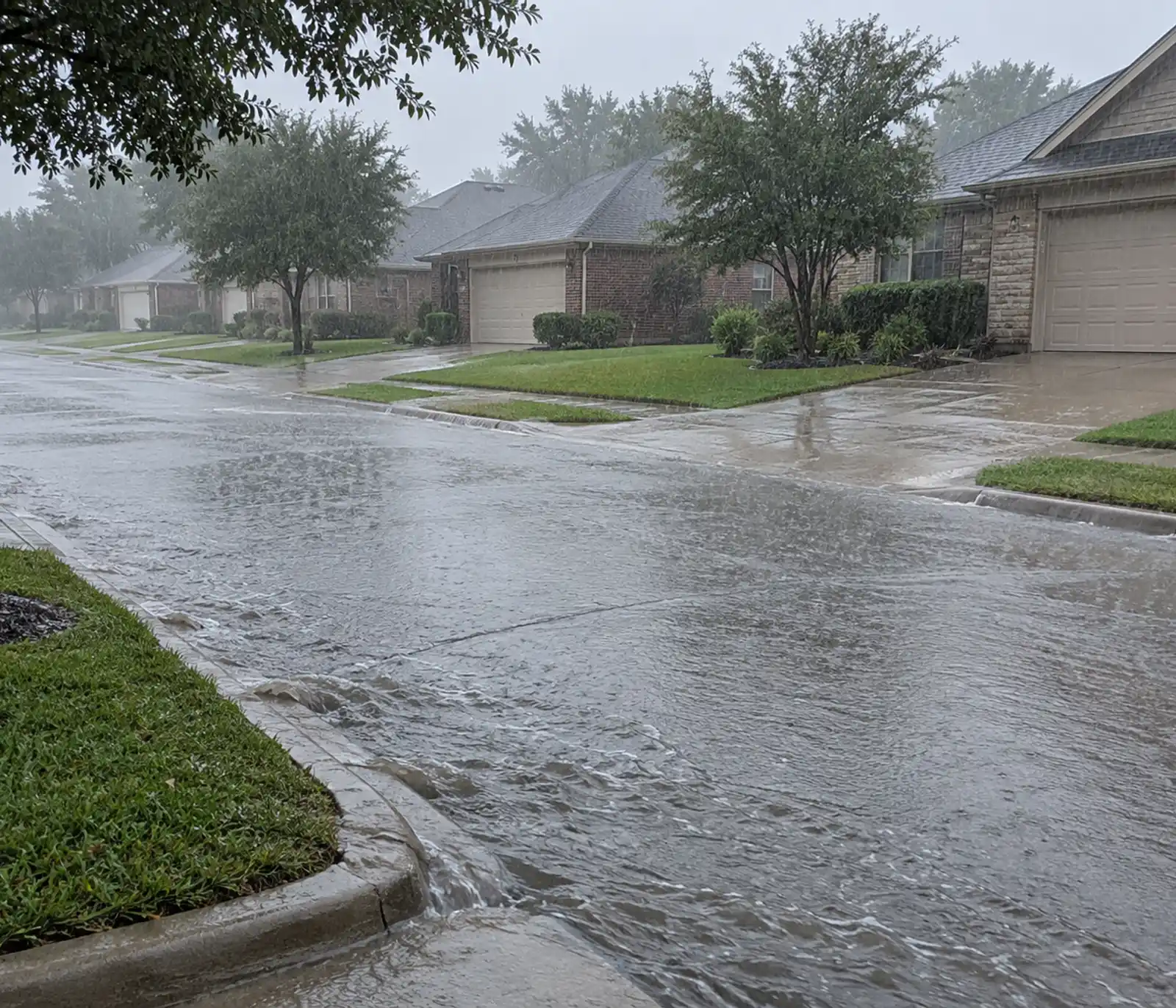
Street and yard flooding in Hurst, TX
What the flood maps cover, what they don't, and what the city does when a storm is coming.
Call (817) 989-2837Most people check one thing after a heavy storm: am I in a flood zone? In Hurst, that question answers less than it seems to.
The City of Hurst has six major watersheds. Every one of them has areas that flood — both from streams rising and from water running down streets and across yards in a downpour. FEMA has mapped the first kind. The city says plainly that the second kind has not been mapped at all.
So a house sitting well outside the mapped limits can still take water through a garage door or a threshold, and the owner may have no flood insurance, because nobody told them they needed it.
How the city manages drainage
The city maintains roughly 14 miles of open-lined channels, and it created a Storm Drainage Utility in 2009 to pay for maintaining and improving the drainage system.
Who handles what
The city
- Sandbags before a storm. City staff deliver up to 20 sandbags per address, dropped near the easement. Placing them and disposing of them afterward is the homeowner's job.
- Bridges and channels. Crews clear debris from bridges after every inch of rain and clean storm drain inlets once a year.
- Blockages in the city's lines. Street flooding, a water main break or an obstruction in the city's sewer goes to Public Works Dispatch, 24 hours a day: 817-788-7212.
- Floodplain questions. The city's floodplain administrator can be reached on 817-788-7080.
Yours
- Your service lines. The water and sewer lines running from the house out to the point where the city's system takes over are the property owner's to maintain.
- Drainage on your lot. Water that ponds against the house, a blocked yard drain, a regraded neighboring lot — none of that is city infrastructure.
- Flood insurance. Standard homeowners policies generally don't cover water that comes in from outside. Hurst takes part in the National Flood Insurance Program and the Community Rating System, where its class 8 rating gets residents a 10% reduction on federally backed flood insurance premiums.
- What's already in the house. Once water is inside, drying it is a restoration job, whether it came from the street or a pipe.
Water already inside? Call (817) 989-2837 — answered any hour.
When street water gets into the house
Storm water that reaches the inside of a house is rarely clean. It picks up whatever is on the driveway and in the street, and if a sewer is surcharged anywhere nearby, it can carry that too. Treat it as contaminated: keep children and pets out of it, and don't run a household vacuum over it.
What matters next is time. Carpet pad, the bottom of drywall, baseboards and the subfloor under them soak water up and hold it. Twenty-four hours of standing water is a different job from two hours of it, and a garage slab that looks dry by morning can still be wet under the paint.
After the water goes down
A few things worth doing while it's fresh, and before anything gets moved:
Photograph the water at its height if it's safe to, and again once it drops — insurers ask, and the line on the wall fades. Get wet contents up off the floor and out of the room. Leave the power off in any room where water reached outlets. And don't wait on an insurer's approval before drying starts; delay is what turns a repair into a rebuild.
If the water came from the street or a yard rather than a pipe, that's usually a flood insurance question, and the answer depends on whether flood cover was in place.
Water in the house after a storm?
Call (817) 989-2837. You'll reach licensed and insured restoration pros working across Hurst, any hour. The call is free and there's no obligation.