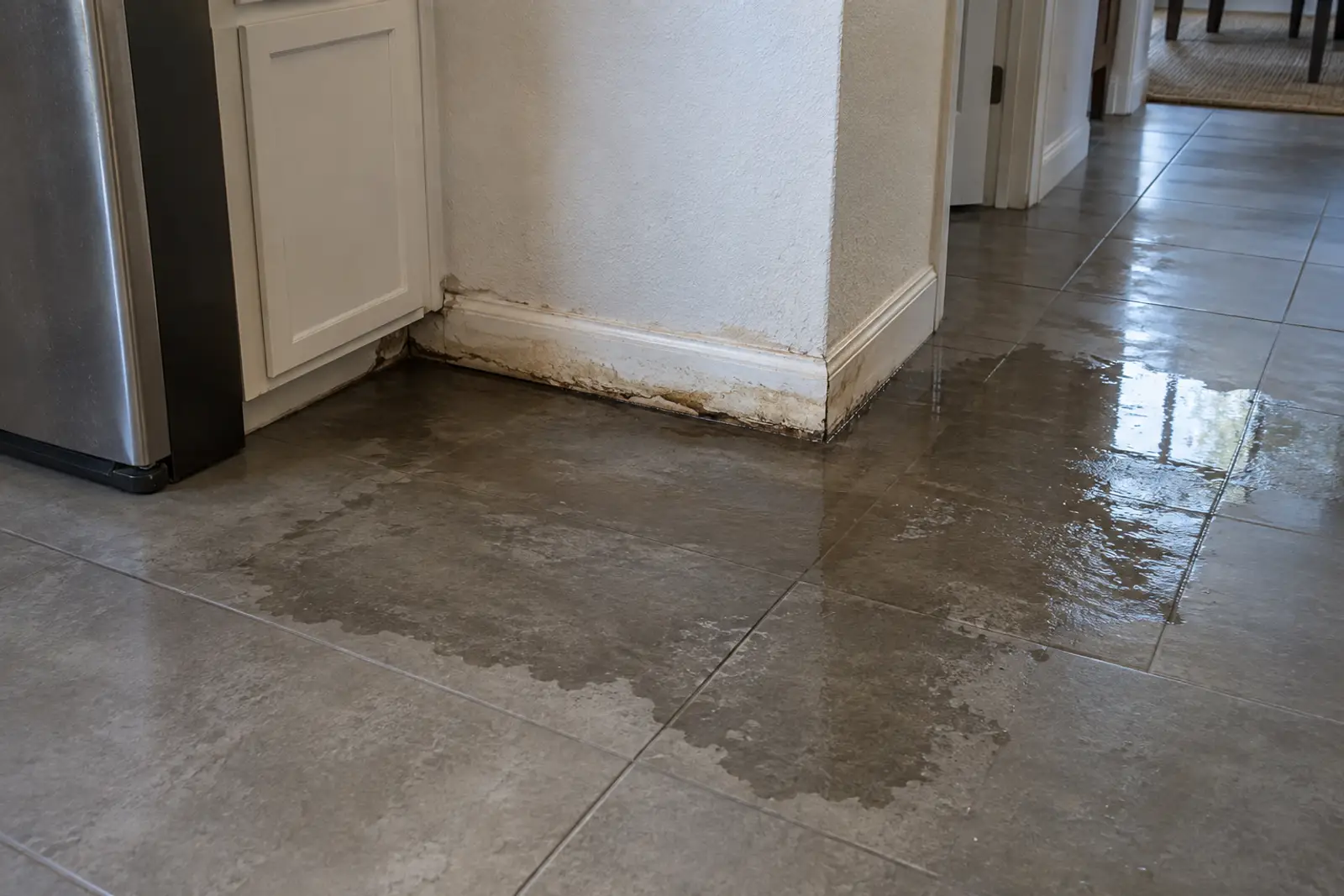
Water seeping up across a floor from the base of a wall

Slab leak water damage in Hurst, TX

Water under a slab has to go somewhere. By the time it shows up through the floor, it's usually been in the flooring, baseboards and bottom plate for a while.

Call (817) 989-2837

How you know

A slab leak rarely announces itself. What people notice first:

Water seeping up through concrete, or coming up under floorboards with no spill to explain it. A patch of floor that's warm underfoot — a hot water line. The sound of running water with every faucet closed. A water meter that keeps turning when nothing in the house is on. A water bill that jumps for no reason. Flooring that lifts, cups or sounds hollow, often near an exterior wall or the garage edge.

Scope — who does what

A plumber finds the leak and repairs the pipe. That's leak detection, pinpointing, and whatever access the repair needs — through the slab or a reroute. We don't do that part and won't say otherwise.

Restoration pros handle everything the water touched: extraction, drying the slab and the framing above it, pulling wet flooring and baseboards, cutting out saturated drywall, and treating what's started to grow. That's what this number reaches.

Most people need both. If a plumber has already been out, the drying should start straight away — a repaired pipe doesn't dry the floor.

The ground under Hurst isn't one thing

~33%
Barely moves — sandy loam
~28%
Moderate movement
~24%
High movement — sandy loam over clay
~2%
Very high — clay, near the river

USDA soil mapping for the Hurst area shows about a third of it on soils that barely move with moisture, and about a quarter on soils that swell and shrink hard. Roughly 13% is urban fill and disturbed ground that isn't rated at all.

That matters because ground that moves with the seasons puts stress on anything rigid buried in it — including the lines under a slab. It also means the advice you'll read about "North Texas clay" may not describe your street at all. Two houses a few blocks apart can sit on quite different ground.

What the water does while it's under there

Water escaping under a slab moves along the path of least resistance, which is often the underside of the slab itself or the fill beside it. It comes up at the weakest seam: a control joint, the edge of the garage, the gap under a bottom plate.

Once it's inside, the wet stays low and spreads sideways. Baseboards wick it. Bottom plates hold it. Carpet pad and the underside of vinyl plank hold it longest, and both hide it well. Cabinet kickboards and the particle board under them swell and don't come back.

The drying is slower than people expect. A slab holds moisture for days after the surface reads dry, which is why drying equipment stays in place and gets checked with meters rather than by hand.

What to do now

Turn the water off at the meter if the leak is running. If it's a hot-water line, switching the water heater off stops it too.

Get contents up off the wet floor, especially anything in a closet backing onto the wet area. Leave baseboards and flooring alone — a restoration crew needs to see the extent before anything is pulled.

Then call a plumber for the pipe and this number for the water. Both can happen on the same day.

FAQ

There's water coming up under my floorboards. Is it a slab leak or something else?

It can also be a leaking dishwasher line, a failed water heater, or storm water that came in low. A slab leak usually shows up with one of the other signs — a moving meter with everything off, a warm patch on the floor, or the sound of running water in a quiet house. A plumber confirms it; the drying starts either way.

Do you do leak detection, or cut into the slab?

No. This number connects you with restoration companies. They handle water removal, drying, and the flooring and drywall repairs that follow. Finding the leak and repairing the pipe is a licensed plumber's work.

The plumber fixed the pipe. Do I still need anything else?

If the water was under the floor for more than a day or two, usually yes. The repair stops the source; it doesn't dry what's already wet. Flooring, baseboards and the bottom of the drywall can stay wet for a long time, and that's where mold starts.

My water bill jumped and the meter keeps moving. Is that an emergency?

Not in the way a burst pipe is, but it shouldn't wait either. Water escaping under a slab is doing damage whether or not you can see it. Turn the water off at the meter between uses if the bill is climbing fast.

Slab leak already found?

Call (817) 989-2837. Answered any hour across Hurst. The call is free and there's no obligation.

Call (817) 989-2837